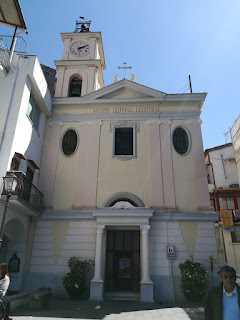
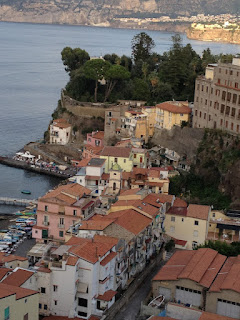
Sorrento is a beautiful town perched on a cliff high above the sea with views of Vesuvius and the islands in the Bay of Naples . Use this website to help you plan a visit to this elegant southern Italian resort and find your way to the best beaches and some lovely villages and towns along the Sorrentine peninsula that are perhaps less well known to tourists.

Showing posts with label Beaches. Show all posts

20260130

Ristorante La Conca

Dine close to the sea at Meta di Spiaggia


To enjoy fresh fish and seafood, good wine, and great views, try lunching or dining overlooking the beach at La Conca Ristorante at Meta Spiaggia, just outside Sorrento.

The restaurant’s menu is based on the catch of the day, so customers are served dishes made from the freshest local ingredients.

You feel as though you are right at the water’s edge on the restaurant’s terrace and can enjoy your seafood and wine while seeing people swimming close by.

La Conca has a reputation for  serving high-quality seafood
La Conca has a reputation for 
serving high-quality seafood
If you are very lucky, you might be able to watch the sun setting on the horizon while having a romantic evening meal.

Ristorante La Conca was opened in 2002 by its owner, Antonio Cafieri, who runs it with his family, helped by a friendly and efficient staff.

The menu is based on Antonio’s reinterpretation of classic Mediterranean dishes, such as antipasto del mare, impepata di cozze (peppered mussels), fritto misto, and polpo (octopus), as well as a good choice of fresh fish.

La Conca’s menu has attracted positive coverage from Gambero Rosso and Osterie d’Italia Slow Food, among others.

Many reviews by diners on line have praised the service, the quality of the food, and the wonderful sunsets they have experienced while enjoying their meals.

Ristorante La Conca is open every day from 12.00 until 15.00 and 19.30 until 23.30.

The beach next to La Conca's terrace
The long expanse of beach known as Meta Alimuri has made the town of Meta, near Sorrento, become a popular seaside resort in its own right.

A short drive, or bus ride, north east of Sorrento, Meta lies between Piano di Sorrento and Vico Equense on the main coastal road going in the direction of Naples.

Via del Mare leads down to the beach from the town, making it accessible by car or bus. There is a good stretch of sand with free access and from the beach there are lovely views across the Bay of Naples.

Meta has a long history of boat building and by the 19th century its shipyards were producing hundreds of boats, with the local women sewing the sails for them in the courtyards of their houses.

Although steamships eventually replaced sailing boats, the shipyards continued to produce the Sorrentine Gozzo, a small sailing and rowing boat that enables the occupant to fish and row at the same time.

It is fascinating to wander through the narrow streets in the historic centre of Meta and see the old houses, with their large courtyards, where boat builders and seafarers lived centuries ago.

Meta has a magnificent church, the Cathedral of Santa Maria del Lauro, which is right in the centre of the town, just off the main road. The town celebrates the Festa of Santa Maria del Lauro every year on 12 September.

The Line A bus from Sorrento to Meta Alimuri will take you close to the beach, or you can travel on the Circumvesuviana train to Meta and walk down to the beach from the station. If you arrive by car there is a parking area near the beach.

Ristorante La Conca is to be found at 111 Traversa Alimuri, Meta di Sorrento.

20240217

Marina Piccola

Historic port is a transport hub for locals and tourists

The harbour at Marina Piccola, the departure point for trips to Naples, Capri and elsewhere
The harbour at Marina Piccola, the departure point
for trips to Naples, Capri and elsewhere
Marina Piccola (small marina) is Sorrento’s main port, from where the car ferries and hydrofoils depart for Naples, the islands of Capri, Procida and Ischia, and the Amalfi coast. 

Confusingly for visitors to Sorrento, Marina Grande (big marina), Sorrento’s other port, has more of the atmosphere of a fishing village, with small boats lined up on its beach and a good choice of restaurants, bars, and shops.

At one time, Marina Piccola could be reached only by a long flight of steps, but now there is a road - Via Luigi de Maio - leading to it from Piazza Tasso, which buses and taxis use to transport hundreds of local people and visitors up and down each day.

A double lift was installed in Villa Comunale, which overlooks the port, in 2012, to save passengers from the uphill walk when they have arrived by boat. With a capacity of eight passengers in each lift, it replaced an earlier, single-shaft elevator that closed in 2006. 

The pretty Church of Santa Maria del Soccorso at Marina Piccola
The pretty Church of Santa Maria
del Soccorso at Marina Piccola
The cost to ride up or down in the lift is 1.10 euro and it is in operation from 7.30 am each day. Travellers returning from a day trip to Capri, Ischia or Naples can be whisked up from the port to Piazza Gargiulo in the Villa Comunale in just 20 seconds, although at busy times there can be a queue to use the lift.

From Villa Comunale it is just a few minutes’ walk to Piazza Tasso and the shops, bars, restaurants, and hotels in the centre of the resort.

As well as bars and restaurants around the harbour, there is a ticket office at Marina Piccola where you can buy tickets for the boats and hydrofoils.

From Marina Piccola, you can access the areas of pebbly sand set out for sun bathing and swimming, such as Leonelli’s Beach, Peter’s Beach, Marameo Beach and Bagni Salvatore. 

But these can be crowded, and the hire charge for sun beds and beach umbrellas is likely to be higher than at beaches outside the centre of Sorrento.

Old documents have been found in which Marina Piccola is referred to as ‘portus capi cerbuli’, which seems to signify it has a long history of being the main port of Sorrento. It has its own small church, tucked away in a corner, the pretty pink and grey Church of Santa Maria del Soccorso, which is thought to date back to the 16th century, although it is known that its bell tower was added in 1715.

The statue of the Holy Virgin being positioned on a boat ready for its trip along the coastline
The statue of the Holy Virgin being positioned
on a boat ready for its trip along the coastline
From the church, a statue of the Holy Virgin of Soccorso is loaded on to a boat to take to the water every year on the first Sunday in August, a tradition that enables fishermen and others who make their living on the sea to give thanks to the Madonna for their protection. 

The statue follows a course that takes in the main marinas of the Gulf of Sorrento, at first rounding Capo di Sorrento to pause at Marina di Puolo, then returning to visit the Marinella di Sant’Agnello, Marina di Cassano at Piano di Sorrento and the Spiaggia di Alimuri at Meta. Often the statue is followed by a procession of other boats.

Home


20231011

Piano di Sorrento

See spectacular sunsets from the plain of Sorrento

Looking across the marina at Cassano, the fishing village that forms part of Piano di Sorrento
Looking across the marina at Cassano, the
fishing village that forms part of Piano di Sorrento

A few minutes journey from Sorrento is Piano di Sorrento, a former fishing village situated between Sant'Agnello and Meta as you travel in the direction of Naples. 

Primarily a residential area with plenty of shops, Piano di Sorrento has a marina and two small beaches with an area free for use by the public.

The village of Piano di Sorrento became more prosperous when the supply of power and water was improved, after the creation of a railway tunnel between Vico Equense and Castellammare di Stabia. This moved the area’s economic base from just fishing, agriculture, and boat-building towards tourism.

You can now reach Piano di Sorrento from Sorrento in about five minutes by car, bus or on the Circumvesuviana railway. There are plenty of restaurants and cafes and some hotels and B&Bs in the town.

Piano di Sorrento is divided into two distinct areas, Cassano and Carotto, and above the town are the Colli di San Pietro, hills that have lovely views over the Bay of Naples and the Bay of Salerno.

In the centre of the town is the ninth century Basilica di San Michele Arcangelo and the Villa Fondi de Sangro, which is open to the public and houses the Museo Archeologico George Vallet which houses interesting artefacts unearthed from excavations in the area. You can watch spectacular sunsets from benches in the park belonging to the villa, which is on a high cliff looking out over the Bay of Naples.

The Victorian poet Robert Browning is said to have once stayed in the area and he mentions the countryside of Piano di Sorrento and other places along the Sorrentine peninsula in his poem "The Englishman in Italy".


Home


20220220

Chiesa di Sant’Anna at Marina Grande

Pretty church at the heart of an annual celebration

The church, with its pink and green façade, is set in its own square
The church, with its pink and green
façade, is set in its own square
Right in the middle of Marina Grande, set back from the beach in its own little square, is a pretty 17th century church dedicated to Saint Anne (Sant’Anna), the mother of the Virgin Mary.

The Baroque church, with its pink and cream façade, was built on the site of a much earlier church and paid for by the local fishermen. Originally, the church was dedicated to souls in purgatory, but it was later rededicated to Saint Anne, the grandmother of Jesus.

It is about a ten-minute walk from Piazza Tasso to visit the church. You go through Piazza Vittoria and along Via Marina Grande and as you descend to the seafront, you will catch a glimpse of the green and yellow patterned cupola and the campanile of the parish church.

Walk along the seafront past the Da Emilia restaurant and you will find the church on your left. The entrance door, flanked by two marble columns, leads into the simple interior, which has a single nave and a wooden trussed ceiling. Behind the main altar is a statue of Saint Anne and the church also has sculptures of the crucified Christ and John the Baptist.

The floor is covered in white and grey marble and on the opposite wall of the church, high above the entrance door, is a pipe organ.

The church's green cupola can be  seen in the centre of this picture
The church's green cupola can be 
seen in the centre of this picture 
The feast day of the Saints, Anne and Joachim, who were the parents of Mary and grandparents of Jesus, is celebrated on 26 July each year at Marina Grande. A few days before, lights shaped like sea shells and sweet stalls appear alongside the long-established restaurants and bars.

It is a tradition that handmade handkerchiefs are sold from one of the stalls, along with a special blessing offering protection to pregnant women, as Saint Anne is also the patron saint of pregnancy and motherhood.

The first Sunday after 26 July, trumpets sound early in the morning to herald the beginning of a large procession, when the statue of Sant’Anna is carried around Sorrento. People come by boat afterwards to join in the celebrations at Marina Grande and eat traditional Sorrento specialities at the restaurants.

The day ends with spectacular fireworks that light up the bay, accompanied by classical music, signalling the end of the festivities for another year.


Home


20200226

Sant’Agnello

 Popular resort just a short walk from Sorrento


The small resort of Sant’Agnello, just outside Sorrento in the direction of Naples, is very popular with visitors. Many holidaymakers like to base themselves there and visit Sorrento during the day, returning to its peaceful atmosphere in the evenings.

You can reach Sant’Agnello from Sorrento by walking along Corso Italia, passing Piazza Lauro and Viale Nizza, until you reach Piazza Sant’Agnello. You will see the yellow-painted façade of the Chiesa Santi Prisco ed Agnello, dedicated to San Prisco, a fifth century bishop from Nocera in Campania, and Sant’Agnello, a sixth century monk from Naples, who is now the patron saint of the town.
Church dedicated to Sant'Agnello's patron saint

You can also reach Sant’Agnello by leaving Sorrento along Via Correale, passing the Museo Correale di Terranova, and turning right along Via Aniello Califano. You pass the Church of Santa Maria della Rotonda and then join Via Bernardino Rota. After you pass the Grand Hotel Cocumella you can descend to the beach of Marinella, where you can hire sun loungers and enjoy the beautiful view over the bay of Naples.

Sant’Agnello was made famous by the American novelist, Francis Marion Crawford, who was born in 1854 in Bagni di Lucca in Tuscany.

A prolific novelist, Crawford became known for the vividness of his characterisations and the realism of his settings, many of which were places he had visited in Italy.

He chose to settle in later life in Sant’Agnello, where he even had a street named after him, Corso Marion Crawford, which is another way to get down to the sea from Corso Italia.

In 1883 Crawford lived at the Hotel Cocumella in Sant’Agnello, the oldest hotel in the Sorrento area. He then bought a farmhouse nearby, from which he developed the Villa Crawford, an impressive clifftop residence that is easily identifiable from the sea.

Crawford died at the Villa Crawford after suffering a heart attack in 1909. The villa, which was donated to a religious order by his descendants, has since been refurbished as a guesthouse.

The Hotel Cocumella, where Crawford stayed during the 1880s, is in Via Cocumella, just off Corso Marion Crawford. Over the centuries it has welcomed writers such as Goethe, Mary Shelley and Hans Christian Anderson, along with many artists, statesmen and noblemen who visited it while they were on the Grand Tour.

20190910

Sorrento beaches


Sorrento has a reputation for being a seaside resort without any good beaches, but there are some great places for swimming and sunbathing just out of town if you know where to look.

Many of the hotels in the centre of the resort have their own stretches of beach for the use of guests. But if your hotel doesn’t have its own beach there are small strips of beach accessible from the centre of town for people who don’t have time to explore further afield.

Take the lift from Villa Communale to Marina Piccolo, at a cost of one euro, to access the beach next to the harbour and other areas of pebbly sand set out for sun bathing and swimming, such as Leonelli’s Beach, Peter’s Beach, Marameo Beach and Bagni Salvatore. But they can be crowded during the summer and the hire charge for sun beds and beach umbrellas is likely to be higher than the cost at beaches outside the centre.
Bathing platforms in the cenntre of Sorrento.

You could also walk down Via Marina Grande to Sorrento’s other port, where there is a stretch of public beach as well as a wooden bathing platform with sun beds and umbrellas for hire. Down at Marina Grande you are handy for some good bars and fish restaurants.

If you head south west out along the Sorrento peninsula you will come to several good beaches.

To see stunning views in different directions across the bay of Naples, visit the point of land protruding from the Sorrento peninsula known as Punta del Capo. To get there leave Sorrento along Via del Capo in the direction of Massa Lubrense. You could walk, taking in the view over Marina Grande along the way, but it is uphill and can be hard work in hot weather. Or, you could take the Linea A (Line A) orange bus to Capo di Sorrento from Piazza Tasso, which takes about ten minutes.

Get off at Capo di Sorrento, where there are a few shops and a bar, and you will see a signpost pointing to i ruderi romani (Roman ruins). It is a pleasant walk down to the sea along Via Punta Capo past the church of San Rosario.
The beach at Marina Grande

You will come first to a natural triangular pool with an archway of rock over it, which is known as il Bagno della Regina Giovanna (Queen Joan’s bath). The clear shimmering water of the pool is popular for swimming and snorkelling. On the tip of Punta del Capo are the ruins of a large Roman villa which would once have had grand rooms with panoramic views of the bay and access from the sea for visitors arriving by boat. You can sunbathe and swim in the sea off a narrow strip of rock nearby where there is a bar and access to toilets.

A lovely stretch of public beach can be found at the old fishing village of Marina di Puolo further out along the peninsula.

To get there, take the Linea A (Line A) bus to Capo di Sorrento and get off at the stop for the Hotel Dania, from where you can make your way down to the beach along an old path.

Turn off Via Capo down Calata Puolo and then turn left again to go down some gradual steps and along a narrow path past olive groves and a vineyard until you reach the intersection with Via Marina di Puolo. You will pass a car park (the nearest point to the beach that you can drive to if you come from the main road) before going down a steeply descending, winding path to reach Marina di Puolo.

You will find a shop, a few restaurants and a hotel with its own private area of the beach when you get down there. There is a good stretch of grey, volcanic sand open to the public. You can hire sunbeds, deckchairs and umbrellas from the resident bagnino, who can usually be found near the restaurant Da Raffaele. Along with his helpful staff, he provides good customer service and keeps the beach in good order.
A lone swimmer at the beach at Marina di Puolo

When you enter the sea, it is shallow for the first few metres. Once you have crossed a pebbly area, you will find it is soft under foot and the water is pleasant for bathing. 

After your swim you will enjoy having lunch outside one of the restaurants along the sea front enjoying the view while you sample the fresh fish and local wine. You can see Vesuvius and the coastline across the bay. To the right is the rocky end of Punta del Capo and to the left there is a promontory of land known as Capo di Massa, which is surmounted by the remains of a 16th century look out tower.

Marina di Puolo can be crowded on Saturdays and Sundays during the summer when many Italian families head for the beach. But on weekdays it is a pleasant place to escape to.

Further along the peninsula you will come to the pretty, seaside village of Marina della Lobra, with its sandy beach that is rare for the area.From the town of Massa Lubrense, you can walk down to the seafront along a winding road. When you reach Marina della Lobra, there are restaurants and bars, a beach that is free to the public and places where you can hire boats.

During the summer, you can take a boat trip from the harbour to explore the coastline and get a closer view of Capri and the Amalfi coast. A few buses run between Marina della Lobra and Massa Lubrense, so check the timetable if you would prefer to ride back up the hill rather than walk. 

The local Linea A (Line A) buses operated by EAVBUS run all the way out to Massa Lubrense from Sorrento during the summer. The SITA coaches that connect Sorrento with resorts such as Positano and Amalfi further along the coast call at Massa Lubrense all the year round. The journey from Sorrento to Massa Lubrense’s main square takes about 15 minutes.

Further out along the peninsula, accessible by car or bus, is Nerano, which has a lovely beach down at Marina del Cantone, near the tip of the Sorrentine peninsula.

Marina del Cantone looks out over the gulf of Salerno and is situated between the bay of Ieranto and Recommone. Its pebbly beach is ideal for sunbathing and you can hire sunbeds and beach parasols. The clear water of the sea in this part of the bay makes it perfect for swimming and snorkelling.

You can walk from Marina del Cantone along a panoramic path to the beach at Recommone, which takes about ten minutes. You will pass a 15th century watch tower which was built to look out for pirates and invaders.

Down at Marina del Cantone you will be able to book boat trips to the other coves along the coast, to the three islands out in the bay known as Li Galli, or, to visit the Grotta Azzurra, (blue grotto) on the isle of Capri. If you arrive at Marina del Cantone by car you will find a parking area near the hotels, shops, bars and restaurants just above the beach.

Going north east out of Sorrento in the direction of Castellamare di Stabia you will pass several towns with beaches.

The nearest is at Sant’Agnello,where you can access the sandy beach at Lido Marinella, which has good facilities and restaurants.

Further along, there is a long expanse of beach known as Meta Alimuri, which has made the town of Meta, near Sorrento, a popular seaside resort in its own right. Meta lies between Piano di Sorrento and Vico Equense on the main coastal road going in the direction of Naples.

A road leads down to the beach from the town, making it accessible by car or on foot. There is a good stretch of grey volcanic sand with free access, even though some Meta hotels have their own private sections of beach. From the beach there are lovely views across the Bay of Naples
There is a bar and restaurant down at the beach, deck chairs and sun umbrellas can be hired and there are opportunities to rent boats.

The Line A bus from Sorrento to Meta Alimuri will take you close to the beach or you can travel on the Circumvesuviana train to Meta and walk down to the beach from the station. If travelling by car, you will find parking close to the beach.


There are also beaches at Vico Marina and Marina di Equa, which can be accessed from the town of Vico Equense, further along the coast.

20190307

Porta Marina Grande – the Greek Gate

Sorrento’s architectural gem


The oldest surviving example of Greek architecture in Sorrento is Porta Marina Grande, usually known as the Greek Gate, which has hardly changed since it was built there by the Greeks when they ruled Sorrento in the fourth century BC.

Sorrento's Greek Gate, built in the fourth century BC, is
also known as Porta Marina Grande
Originally, the gate would have been under a tower and when it was built it probably provided the only access to the city from the sea. Together with a gate built later at Marina Piccola, which no longer stands, it would have been the only outlet for trade with neighbouring cities before the Roman era.

The Greek Gate was incorporated into the 16th century walls built to protect Sorrento from pirates but, sadly, it was the way by which Turkish pirates entered the city on 13 June 1558 when, according to legend, the gate was opened to them by a slave working for the Correale family.

The gate was built in regular rows of blocks of stones and has two archways. You enter through the first and exit through the second archway to walk down the steps into Marina Grande.

The gate blends perfectly with the walls on either side of it and the traditional fishermen’s houses. When you emerge from the passageway into the sunshine you will have a stunning view of the sea and the beach of Marina Grande

The passage through the walls at the Greek Gate opens on to a view of fishing boats bobbing on the sea
The passage through the walls at the Greek Gate opens
on to a view of fishing boats bobbing on the sea
Somewhat confusingly, it is Marina Piccola - the 'small' marina - where large boats dock and hydrofoils from Naples, Ischia, Capri, Positano and Amalfi arrive and depart.

Marina Grande - the 'big' marina - has the feel of a small fishing village that has remained unspoilt over the years and is well worth a visit as there are plenty of restaurants that serve fresh fish.

When you reach the beach you will be greeted by the sight of brightly painted bathing huts along a platform over the sea and lines of small fishing boats and pleasure boats on the beach.

You may even see fishermen among them mending their nets as fishing by traditional methods is still an important part of Sorrento ’s economy.

There are also a few shops, bars and restaurants at Marina Grande but, despite receiving many visitors, there is a homely atmosphere where everyone knows everyone else because the same families have lived there for generations.

Home

20180319

Marina della Lobra


Fishing village with beach 


The pretty, seaside village of Marina della Lobra, with its stretch of sandy beach that is rare for the area, is a lovely place to visit.

From the town of Massa Lubrense, which is further out along the peninsula from Sorrento, you can walk down to the seafront along a winding road. When you reach Marina della Lobra, there are restaurants and bars, a beach that is free to the public and places where you can hire boats.
Boats in the harbour at Marina della Lobra

Now a fishing village, Marina della Lobra used to be a small port that was popular as a summer residence for wealthy Romans. Marco Vipsanio, the son in law of Emperor Augusto, is said to have built his villa here.

During the summer, you can take a boat trip from the harbour to explore the coastline and get a closer view of Capri and the Amalfi coast. Or, you can escape the crowds and enjoy a relaxing swim in the sea.

The most important monument is the church dedicated to Santa Maria della Lobra, which dates back to the 16th century, when it was built over the ruins of a former Roman temple. The church organ is supported by two ancient columns that may have been salvaged from the original temple and the church still has a 17th century wood carved ceiling and an 18th century majolica floor. The adjacent 17th century cloister was built when there was a Franciscan convent on the site.

A few buses run between Marina della Lobra and Massa Lubrense, so check the timetable if you would prefer to ride back up the hill rather than walk.

How to get to Massa Lubrense:


The local Linea A (Line A) buses operated by EAVBUS run all the way out to Massa Lubrense from Sorrento during the summer. The SITA coaches that connect Sorrento with resorts such as Positano and Amalfi further along the coast call at Massa Lubrense all the year round. The journey from Sorrento to Massa Lubrense’s main square takes about 15 minutes.

20170212

The Shooting in Sorrento


A new crime novel set against the beautiful backdrop of Sorrento is now available via the Amazon website.

Much of the action in the novel takes place in the ancient streets in the centre of the resort and at locations out along the Sorrentine peninsula.

The Shooting in Sorrento - written by Best of Sorrento editor Val Culley -  is the second Butler and Bartorelli mystery and is the sequel to Death in the High City, which was set in Bergamo in Lombardy.

The main protagonist, journalist Kate Butler, is in Sorrento with her partner, Steve Bartorelli, a retired Detective Chief Inspector, to attend the wedding of the daughter of one of Steve’s Italian cousins.

The couple get to know an English family staying at their hotel in Capo di Sorrento and when tragedy strikes them, Kate feels she should try to help. She has already become friends with the mother of the family, Janice, who is a woman of about her own age.

Steve is distracted by meeting up with Italian relatives he has not seen since he was a child and is also wary of becoming too involved with the family because two of his cousins are senior officers in the Polizia di Stato.
The seafront at Marina di Puolo

But Kate is determined to get justice for her new English friends and joins forces with another visitor to Sorrento to investigate, when it seems the Italian police are focusing all their interest on the English family.

Her enquiries cause her to wander the narrow streets that run parallel to Corso Italia and take her down to the beach at Marina di Puolo, but she ends up putting herself in danger when her sleuthing gets her too close to the truth.

The Shooting in Sorrento is believed to be the first British crime novel set in Sorrento and is available to buy in paperback or as a Kindle edition from Amazon.

Home

20170127

Meta

Enjoy the beach of Meta Alimuri


The sweep of beach at Meta is in the foreground with the Sorrentine Peninsula stretching into the distance
The sweep of beach at Meta is in the foreground with the
Sorrentine Peninsula stretching into the distance
The long expanse of beach known as Meta Alimuri has made the town of Meta, near Sorrento, a popular seaside resort in its own right.

A short drive, or bus ride, north east of Sorrento, Meta lies between Piano di Sorrento and Vico Equense on the main coastal road going in the direction of Naples .

A road leads down to the beach from the centre of the town, making it easily accessible by car or bus. There is a good stretch of grey, volcanic sand with free access, even though some Meta hotels have their own private sections of beach. From the beach there are lovely views across the Bay of Naples.

There is a bar and restaurant next to the beach, deck chairs and sun umbrellas can be hired and there are opportunities to rent boats.

The name 'Alimuri' is said to relate to a story from the early 16th century when a feared Saracen pirate called Alì landed at the beach only to be confronted by local people.  In the fight that followed, Alì was killed, prompting jubilation in the crowd. The shout of 'Alì muri' went up, telling people in the town above the beach that the enemy had been beaten.

Look for a hotel in Meta with Expedia

Meta has a long history of boat building and by the 19th century its shipyards were producing hundred of boats, with the local women sewing the sails for them in the courtyards of their houses.

Although steamships eventually replaced sailing boats, the shipyards continued to produce the Sorrentine Gozzo, a small sailing and rowing boat that enabled the occupant to fish and row at the same time.

The facade of the Cathedral of Santa Maria del Laura at Meta
It is fascinating to wander through the narrow streets in the historic centre of Meta and see the old houses where boat builders and seafarers lived centuries ago, with their large courtyards.

Meta has a magnificent church, the Cathedral of Santa Maria del Lauro, which is right in the centre of the town, just off the main road.

The church was built in medieval times on the site of an ancient temple after a local deaf and dumb woman was said to have found a statue of the Virgin Mary under a laurel tree and then miraculously had her hearing and speech restored.

It was rebuilt in the 16th century and restored and modified in the 18th and 19th centuries. The wooden door is from the 16th century building and the Chapel of the Madonna del Lauro has an old wooden statue of the Virgin and frescoes from the 18th century.

Meta celebrates the Festa of Santa Maria del Lauro every year on 12 September.

The Line A bus from Sorrento to Meta Alimuri will take you close to the beach, or you can travel on the Circumvesuviana train to Meta and walk down to the beach from the station.

If travelling by car, you will find parking close to the beach, but spaces can be in big demand during the summer months.

Check out hotels in Sorrento from Hotels.com

Home


20140728

Sorrento lift

Let the lift from the port do the hard work for you

The long, tiring climb uphill from the port or beach is a thing of the past for Sorrento visitors and residents.
Sign for the lift in
 Villa Communale

Two lifts now connect the centre of town with Marina Piccola and the nearby beaches.
Travellers returning from a day trip to Capri, Ischia or Naples can be whisked up from the port to Piazza Gargiulo in the Villa Communale in 20 seconds.
From there it is just a few minutes walk to Piazza Tasso and the shops, bars, restaurants and hotels in the centre of the resort.
A single trip costs 1 euro but you can also buy a return ticket for 1.80. Between May and September the lift runs from 7.30 in the morning till midnight. For more information visit www.sorrentolift.it.

Home

20130803

Spaghetti alla Nerano

Serve up memories of Sorrento with this authentic pasta dish


Spaghetti with zucchini (courgettes) or Spaghetti alla Nerano is a dish that was born on the Sorrentine Peninsula and tastes best when eaten while looking at the stunning sea views.
Spaghetti alla Nerano cooked to perfection!
But this delicious pasta dish is very simple to make and will conjure up wonderful memories of the bay of Naples and the holiday you enjoyed there, wherever in the world you serve it up.
It is believed to be the invention of a lady called Maria Grazia, the proprietor of Ristorante Maria Grazia down at Marina del Cantone which overlooks the beach below Nerano just a few kilometres south of Sorrento out along the peninsula.
The only ingredient you might find difficult to get when you are away from Italy is provolone or caciocavallo cheese, but you can always double the amount of parmesan that you use instead.
For centuries there was a restaurant on the beach at Marina del Cantone providing meals for the local fishermen.
Ristorante Maria Grazia started up in 1901 and the owners claim to have invented Spaghetti alla Nerano at the beginning of the 1950s.
But you will now find this dish on the menus of the other restaurants at Marina del Cantone and at restaurants in the resort of Sorrento itself.
For four people you will need:
400 gr spaghetti
700 gr zucchini (about four whole zucchini)
extra virgin olive oil
2 cloves of garlic
sea salt
black pepper
100 gr provolone or caciocavallo cheese cut into cubes
100 gr grated parmesan
fresh basil
Cut the zucchini into thin slices and fry in hot oil. Take off heat before they start to burn. Blot dry on kitchen paper, then plunge into boiling water for a few seconds and then drain.
Cook the spaghetti until al dente
Brown the garlic in olive oil in a frying pan. Remove the garlic, add more oil and some sea salt and then add the drained zucchini. Add the spaghetti with a ladle full of the water it was cooked in. Add the cheese and black pepper, mix well and serve topped with leaves of fresh basil. Buon appetito!

Home

20120410

Swim and sunbathe at Marina del Cantone

The beach at Marina del Cantone
One of the best beaches in the area around Sorrento can be found at Marina del Cantone, just below Nerano near the tip of the Sorrentine peninsula.
Marina del Cantone looks out over the gulf of Salerno and is situated between the bay of Ieranto and Recommone. Its pebbly beach is ideal for sunbathing and you can hire sunbeds and ombrelloni (beach parasols).
The clear water of the sea in this part of the bay makes it perfect for swimming and snorkelling.
You can walk from Marina del Cantone along a panoramic path to the beach at Recommone, which takes about ten minutes. You will pass a 15th century watch tower built to look out for pirates and invaders - a regular hazard faced by local people at the time.
Down at Marina del Cantone you will be able to book boat trips to the other coves along the coast, to the three islands out in the bay known as Li Galli, or to visit the Grotta Azzurra (blue grotto) on the isle of Capri.

How to get to Marina del Cantone


Marina del Cantone
There are regular buses from Sorrento to Nerano out on the peninsula and some go all the way down to Marina del Cantone just below. The journey takes about an hour.
If you have to get off in Nerano it is an easy walk from the centre of the village down to Marina del Cantone.
If you arrive at Marina del Cantone by car you will find a parking area near the hotels, shops, bars and restaurants just above the beach.

Dine at the captain’s table


One of the most prestigious restaurants in the Sorrento area, Taverna del Capitano, is right next to the beach in Piazza delle Sirene at Marina del Cantone.
Taverna del Capitano
Run by the Caputo family for generations, the restaurant is in a converted fisherman’s cottage and offers an extensive menu featuring fresh fish, local produce and wine.
Above the restaurant the Locanda del Capitano has a number of guest rooms each with a private balcony overlooking the beach.
The rooms still have their original vaulted ceilings but are decorated with Vietri ceramics and have the modern comforts of air conditioning, minibar and satellite television.

Home

20120128

Sun, sea and sand at Marina di Puolo

Marina di Puolo
Sorrento has developed a reputation for being a seaside resort without any good beaches.
It is true that near the centre of town there is only Peter’s Beach, a small strip of sand, which can be used by the public, although many of the big hotels have their own tiny areas of beach.
But there are some great places for swimming and sunbathing just out of town if you know where to look.
A lovely beach with an expanse of sand that is free to use can be found at the old fishing village of Marina di Puolo, south of Sorrento and just a little further along the peninsula from Villa Pollio and the Baths of Queen Joan at Punta del Capo.

How to get to Marina di Puolo

Marina di Puolo has a good, sandy beach
Leave Sorrento along Via del Capo in the direction of Massa Lubrense. If you take the Linea A (Line A) bus to Capo di Sorrento, get off at the stop for the Hotel Dania, from where you can make your way down to the beach along an old path.
Turn off Via Capo down Calata Puolo and then turn left again to go down some gradual steps and along a narrow path past olive groves and a vineyard until you reach the intersection with Via Marina di Puolo. You will pass a car park (the nearest point to the beach that you can drive to if you come from the main road) before going down a steeply descending, zig-zagging path to reach Marina di Puolo.


What does Marina di Puolo have to offer?

You will find a shop, a few restaurants and a hotel with its own private area of the beach when you get down there.
However, there is a good sized stretch of the grey, volcanic sand open to the public. You can hire sunbeds, deckchairs and umbrellas from Angelo, the resident bagnino, who can usually be found near the restaurant Raphael.
The view from the Raphael restaurant
Angelo and his helpful staff provide excellent customer service and keep the beach in good order.
When you enter the sea, it is shallow for several metres and you can wade out quite a long way before you begin to get out of your depth. Once you have crossed an area that is rather pebbly, you will find it is soft under foot and the water is pleasant for bathing. There is a substantial area for safe swimming, separated by a rope from the moored boats.
After your swim you will enjoy having lunch outside one of the restaurants along the sea front enjoying the view while you sample the delicious fresh fish and the local wine.
You can see Vesuvius and the coastline across the bay. To the right is the rocky end of Punta del Capo and to the left there is a promontory of land known as Capo di Massa, which is surmounted by the remains of a 16th century look-out tower.
Marina di Puolo can be crowded on Saturdays and Sundays during the summer, when many Italian families head for the beach. But on weekdays it is a pleasant place to escape to.


Home