Sorrento is a beautiful town perched on a cliff high above the sea with views of Vesuvius and the islands in the Bay of Naples . Use this website to help you plan a visit to this elegant southern Italian resort and find your way to the best beaches and some lovely villages and towns along the Sorrentine peninsula that are perhaps less well known to tourists.

Showing posts with label Centro Storico. Show all posts

20230207

O’Parrucchiano

Sorrento restaurant where culinary secrets of former priest still delight diners

O'Parrucchiano has been serving diners on Sorrento's Corso d'Italia since 1868
O'Parrucchiano has been serving diners on
Sorrento's Corso d'Italia since 1868
One of the longest established restaurants in Sorrento, O’Parrucchiano continues to serve high-quality, traditional Sorrento dishes in a magical setting, despite being right in the centre of the resort.

Although O’Parrucchiano is just off the busy Corso d’Italia, you feel as though you are in a citrus grove as you sit on the glass-covered dining terrace, surrounded by a garden filled with lemon trees.

O’Parruchiano was originally named La Favorita when it first opened as a tiny trattoria in just two rooms, a few metres away from Sorrento's Duomo, in 1868. The founder, Antonio Ercolano, had learnt the art of cooking while working for the Archbishop of Sorrento.

Because of Antonio’s past connections with the priesthood, he gained the nickname of ‘o’parrucchiano’, which in Neapolitan dialect means, parish priest.

The restaurant became famous for its cannelloni, which Antonio originally named strascinati when he first created the dish more than 100 years ago. Cannelloni did not appear on the menus of other restaurants until well into the 20th century.
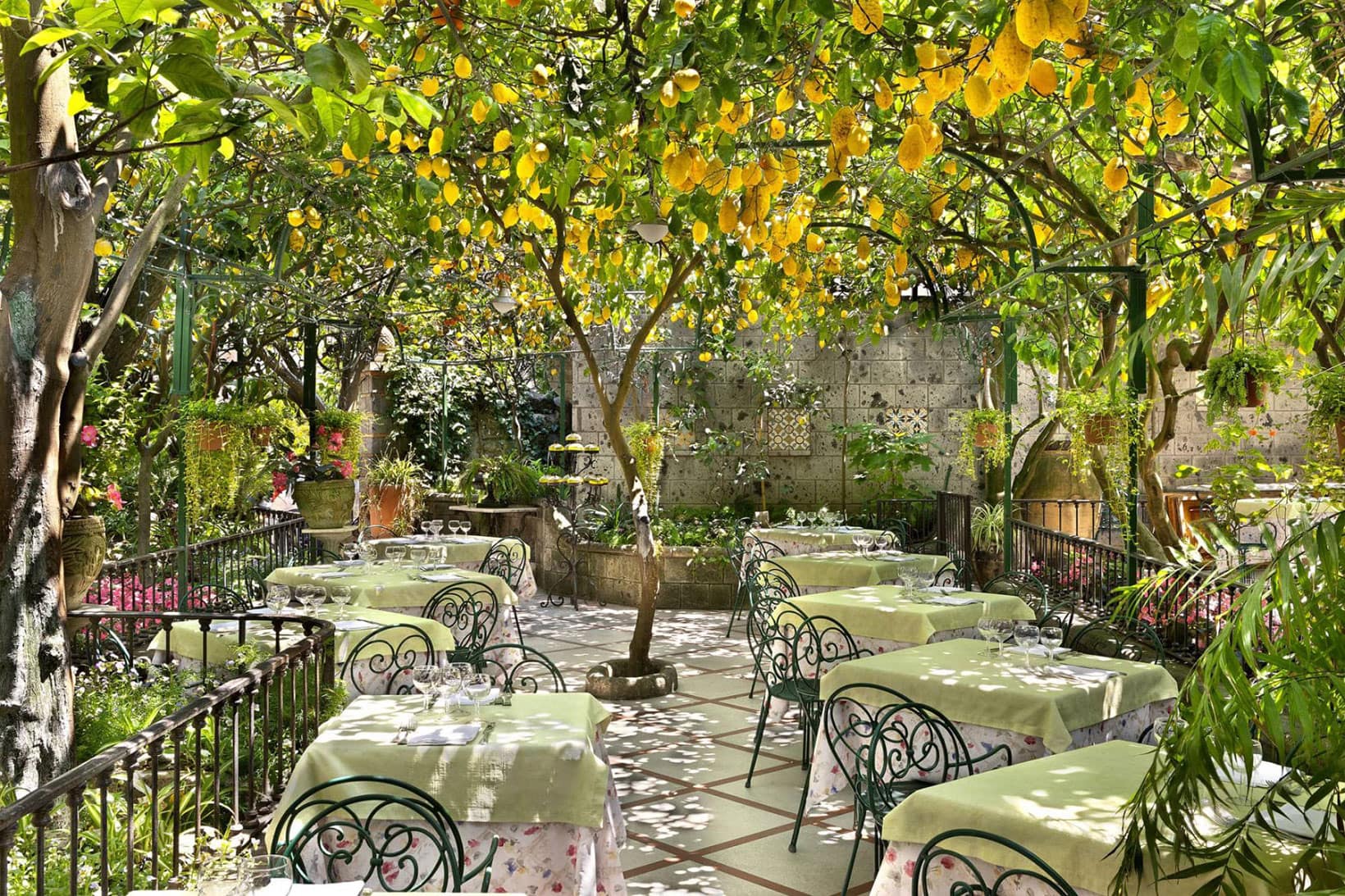
Diners on O'Parrucchiano's upper terrace feel like they are eating in a lemon grove
Diners on O'Parrucchiano's upper terrace
feel like they are eating in a lemon grove
Antonio bequeathed his restaurant to his young nephew, Giuseppe Maniello, after teaching him all his culinary secrets. Giuseppe then enlarged the original trattoria and helped it to become more widely known.

O’Parrucchiano was invited to be included in the Association of Historical Places of Italy and it has been featured in magazines and newspapers in many different countries. In 1958, it was awarded the title ‘Excellent Kitchen’ by the Academy of Italian Cooking.

Over the years, many famous people from the worlds of art, culture, entertainment, and sport have dined there.

Giuseppe’s son, Enzo has since taken over the running of the restaurant, and is helped by his two sons, Giuseppe and Mario, who represent the fourth generation of the family of the founder, Antonio.

The restaurant has a botanical atmosphere throughout
The restaurant has a botanical
atmosphere throughout
O’Parrucchiano’s two spacious dining rooms, furnished with statues, amphorae and other family heirlooms, provide the perfect setting for diners to enjoy the wide selection of Sorrentine specialities on the menu.

You can start with some local seafood and fish antipasti dishes. For primo piatto, you can choose between the famous cannelloni del centenario, gnocchi alla Sorrentina or risotto alla pescatora, among the many other pasta and rice dishes on offer.

For secondo piatto, you have the choice of scallopina alla sorrentina, maiale di Avellino, pesce all’acqua pazza or alla brace, and alici locali as well as many more tempting dishes, which are served with the tomatoes, lemons, vegetables and herbs that provide the authentic aromas and flavours of the Bay of Naples. Buon appetito!


Home


Booking.com

20210322

Basilica di Sant’Antonino

Church displays whalebone to commemorate brave deed by saint

The Basilica di Sant'Antonino dates back to at least the 11th century
The Basilica di Sant'Antonino dates
back to at least the 11th century
The Basilica di Sant’Antonino in Sorrento, considered the town's most important church after the Duomo, is named after one of the city’s patron saints.

The present building in Piazza Sant'Antonino dates back to at least the 11th century, although it is thought to have been built on top of a seventh century oratory housing the saint’s tomb.

The grey tuff façade and bell tower were added during the Renaissance period and the interior was refurbished in baroque style in the 18th century.

Some of the marble columns in the church are believed to have come from villas built in the area by the Romans, which were eventually abandoned.

The church has a beautiful example of a presepe (crib) with 17th century figures made by the best Neapolitan sculptors of the time.

The crypt, which was rebuilt in the 1700s, has many paintings and gifts offered by sailors to fulfil vows they made after they believed their lives had been saved, thanks to the intervention of Sant’Antonino, when they were in peril on the sea.

The pulpit of tarsia (inlaid wood) was made by local craftsmen in the 1930s.

The basilica has a whale rib on display in the
lobby to commemorate Sant'Antonino's bravery
The church was badly damaged in the 16th century by Turkish pirates who succeeded in landing and then invading Sorrento, but it was later restored and refurbished and was made a basilica in 1924.

Antonino Abate, who became Sorrento’s principal saint, died on 14 February, 626 AD. He is credited with saving the life of a child who had been swallowed by a whale by rescuing it from the whale’s stomach.  A whale rib is on display in the lobby of the church to commemorate the brave deed by Sant’Antonino. The saint is also revered by local people for protecting Sorrento against plague and invasion as well as intervening after shipwrecks to save lives.

Each year on the anniversary of his death, a silver statue of Sant’Antonino is carried in a procession through the streets of Sorrento and there are festive lights, fireworks, and musical events in his name.

(Whale rib picture by Mentnafunangann via Wikimedia Commons)

Home

20210201

Poet Torquato Tasso’s birthplace in Sorrento

Renaissance writer came back to Sorrento later in life

Torquato Tasso, who has come to be regarded as the greatest Italian poet of the Renaissance, was born in 1544 in Sorrento.

Tasso’s most famous work was his epic poem Gerusalemme Liberata (Jerusalem Delivered) in which he gives an imaginative account of the battles between Christians and Muslims at the end of the first crusade during the siege of Jerusalem.

Part of Imperial Hotel Tramontano
was Tasso's birthplace
He was one of the most widely read poets in Europe and his work was later to prove inspirational for other writers who followed him, in particular the English poets Spencer and Byron. 

The house where Tasso was born on 11 March, 1544 is in Sorrento’s historic centre, a few streets away from the main square in Via Vittorio Veneto.

The remains of the villa, which was built on the edge of a cliff, now form part of the Imperial Hotel Tramontano.

A plaque on the back wall of the hotel quotes words written by Tasso’s father, Bernardo Tasso, who was also a poet.

Torquato Tasso lived in the villa until 1552 when his father was exiled from Sorrento along with his employer, Prince Ferrante Sanseverino, after they were both accused of being rebels.

Part of the original house where Tasso was born fell into the sea in 1662. Only a room with two arches and balconies overlooking the sea remain. In the 17th century a villa was built incorporating the remains and this eventually became the Imperial Hotel Tramontano, which was opened in 1812.

Tasso’s father, Bernardo, went on to become resident poet at the Ducal Palace in Urbino, enabling his son to study alongside Francesco Maria della Rovere, the heir to the Duke. Tasso was later sent to study law in Padua but he chose to write poetry instead.

Tasso spent years in Ferrara living at the Castle owned by the Este family, where he fell in love with a lady in waiting and wrote love sonnets to her.

He suffered as a result of the jealous behaviour of the other courtiers and this led to him developing a persecution mania and fearing he was going to be poisoned. He also believed he was going to be denounced by the Inquisition.

House of Cornelia Tasso
While still enjoying the patronage of the Duke of Ferrara, Tasso entered a Franciscan convent for the benefit of his health, but later escaped, disguised as a peasant and travelled to Sorrento.

He went to visit his only sister, Cornelia, in her house in the historic centre of Sorrento, situated between the main street and the sea.

You can still see Cornelia’s house, tucked away in a narrow street, Via San Nicola, at number 11. It became known as the Sersale house because Cornelia had married Marzio Sersale in 1558.

Cornelia continued to live in the house with her sons Antonino and Alessandro after she became a widow.

The house can be identified by a pretty little balcony on the front, which is supported by decorative stonework.

It is said that Tasso arrived at Cornelia’s house and pretended to be a messenger who had come to inform her of her brother’s death.

Tasso is believed to have been trying to test Cornelia’s loyalty to him, but her shock and distress on receiving the news was enough to reassure him that she could be trusted.

Despite enjoying happy months with his sister in Sorrento, Tasso found that he missed the court at Ferrara and wrote humbly to the Duke asking if he could come back.

But he continued to be unwell on his return to Ferrara and his erratic conduct eventually led to him being confined in the madhouse of Sant’Anna.

Although Tasso was to enjoy some freedom and was able to travel around Italy again in the last few years of his life, his health started to decline. Tasso died in Rome in 1595 when he was just about to be crowned poet laureate by Pope Clement VIII. He was 51 years of age.

Statue of poet in Piazza Tasso.
To find the house of Cornelia Tasso, leave Piazza Sant’Antonino and walk along Via Santa Maria delle Grazie, which runs parallel with Corso Italia. Continue in a straight line along Via dell’Accademia until it becomes Vico San Nicola. The house of Cornelia Tasso can be found on the right hand side.

Sorrento’s main square, Piazza Tasso was later named after the poet and there is a statue of him there.

Piazza Tasso is the hub of Sorrento, in the middle of the main shopping street, Corso Italia, and looking out over Marina Piccola, Sorrento’s port. Surrounded by bars and restaurants, the square has stops for the local buses and a taxi rank. It is also the resting place for the horses that pull the carriages that can be hired for sightseeing.

Tasso’s statue is set in a pretty little garden opposite Bar Ercolano.


Home

20210111

Chiesa San Paolo Sorrento

Sorrento’s Church of St Paul dates back to the ninth century

One of the most striking features of the Church of Saint Paul, in Via Tasso in the heart of Sorrento’s historic centre, is the carefully-preserved, majolica floor.

The Church has a single aisle
The designs featuring animals, leaves and flowers that were  painted on the terracotta tiles by artists from Naples in the 18th century are still visible to visitors today.

Documents show that the Church of St Paul already existed in the ninth century and it is known to have been sacked by the Turks during their invasion of Sorrento in 1558.

The Church used to be attached to the old convent of Benedictine nuns of St Paul, but this later became an educational institution.

The current façade was added in 1725 but it still remains incomplete at the top. The lower part is in Doric style with the entrance to the church encased by two columns. The top of the façade is simply painted with a central circular window and there is a tiled cupola and small bell tower.

Inside, the church is in the shape of a Latin cross with barrel vaults and it is decorated with 18th century paintings on the walls and ceiling.

The hand-painted 18th century
 majolica floor
There have been many alterations made over the centuries and after the earthquake of 1731 the church was restored in baroque style.

It still has the wooden boxes overlooking the congregation that the nuns would have sat in when attending services.

There are small chapels on both sides of the church. The one on the right has a door leading to the convent and the one on the left has an entrance to the vestry.

Above the main altar there is an 18th century painting depicting the conversion of Saint Paul of Tarsus, the apostle to whom the church is dedicated. The painting is flanked by statues of Santa Scolastica and San Benedetto.

The Church is in Via Tasso, which goes off Corso Italia, and is on the left hand side before you reach Piazza Vittoria.

Home


20191012

Gnocchi alla Sorrentina


Enjoy the flavours of Campania back home


Named in honour of the beautiful resort of Sorrento, this tasty primo piatto (first course) on many restaurant menus is also easy to make at home.

The sauce for the gnocchi is created from a wonderful blend of three of Campania’s most celebrated ingredients, flavoursome, red tomatoes, piquant green, basil leaves and creamy mozzarella cheese. When the cheese melts into the tomato sauce covering the gnocchi, it binds everything together to create a satisfying, but simple dish.
Tasty Gnocchi served Sorrento style

The gnocchi di patate (potato dumplings) can either be home made, following the recipe given below, or bought fresh or vacuum packed from a supermarket.

Gnocchi di patate were supposedly introduced into the Italian culinary repertoire after the Treaty of Campoformio was signed by France and Austria in 1797 at Campoformido, a village to the west of Udine in Friuli.

Venice was thereafter given over to Austrian rule and, along with the gnocchi di patate, Austrian beer and sausages were also added to the Italian menu at this time.

In Sorrento, you can try Gnocchi alla Sorrentina in the heart of the historic centre at Ristorante Il Pozzo in Via Tasso, where they are finished off by being baked in a wood fired oven.

Or, you can enjoy a sea view while you sample them down at Marina Grande at Trattoria da Emilia, a restaurant that was established by Donna Emilia in 1954. They are on the menu as Gnocchi della Mamma and are cooked to Donna Emilia’s original, traditional Sorrento recipe. They taste delicious when enjoyed while sitting at a table on Da Emilia’s wooden deck, suspended over the sea with the waves lapping against it.

But when you return from Sorrento to colder weather back home, piping hot Gnocchi alla Sorrentina are wholesome, comforting and a wonderful reminder of your holiday.

Recipe for two people:

To make the sauce, fry two chopped cloves of garlic in olive oil and add 500g of peeled, deseeded and chopped tomatoes, or the contents of a 400g can of tomatoes put through a sieve. (If using fresh tomatoes, sieve the mixture after cooking.} Add a pinch of dried oregano, a few fresh basil leaves torn into shreds and season to taste. When the sauce is smooth and reduced, set aside.

To cook the gnocchi, add as many as you require, (about a dozen per person for a first course) to boiling salted water and they will be cooked when they rise to the surface. 

Divide the cooked gnocchi between two, warmed oven proof dishes. Reheat the tomato sauce, adding a drop of olive oil or water if required, and pour over the gnocchi. Cut a mozzarella cheese into cubes and share the cubes between the two dishes and add a good grating of Parmesan cheese to each dish. Finish off in a hot oven for 10 – 15 minutes until the cheese forms a golden crust. Serve immediately, garnished with fresh basil.

To make your own gnocchi, boil 500g of white potatoes in their skins, then peel and mash them. Mix in 200g flour and one egg yolk into the mash. Knead together to make a ball of dough. Take small balls, one at a time and work them with your hands into sausage shapes and cut into two cm pieces. Roll them in flour and press against a fork to give them grooves, which will help the sauce to cling to them.


Buon appetito!

20191003

Sorrento Cathedral bell tower - Il Campanile


Ancient columns still support old Sorrento meeting place


Standing three storeys higher than the other building nearby, the Cathedral’s Bell Tower is a landmark in Sorrento.

The red and yellow stone of the tower can be seen from many street corners in the historic centre of the town and also from points along the Via del Capo and the Via Nastro Verde out along the Sorrentine peninsula.
Cathedral's bell tower

The two lower storeys of the tower probably date back to the 11th century when the Duomo was originally built. But the three upper storeys were added in the 15th century, when the Duomo, which is dedicated to San Filippo and San Giacomo, was rebuilt in Romanesque style.

The bell tower was later given a decorative, blue majolica clock.

From very early in Sorrento’s history, the bell tower has played an important part. The ground floor space under the archway from Via Pietà was used as a meeting place by the people of Sorrento in medieval times. Later, a castle was built in the open space that we now see in Piazza Tasso, and the people used to congregate there for meetings.

Although the castle was demolished a long time ago, the columns that still hold up the bell tower at ground floor level are believed to be a collection of old Roman columns or early Byzantine columns.
Ancient columns support campanile

Therefore, the base of the bell tower existed very early on in Sorrento’s history, long before the Duomo was built and the popular seaside resort that we know today, grew up around it.


20190919

Ristorante Pizzeria Da Gigino

Traditional family-run Sorrento restaurant


In the historic centre of Sorrento, Ristorante Pizzeria da Gigino has been serving up Sorrento’s speciality dishes to locals and visitors alike since 1965.

The restaurant is now run by Ciro and Nino Esposito, but the food they serve has been cooked by generations of their family before them.
Inside Ristorante Da Gigino

If you enter Via San Cesareo from Piazza Tasso, turn into Via degli Archi, the first street off to the right, and at number 15 you will see diners sitting at tables outside the restaurant enjoying the traditional dishes on offer.

You can also choose to eat inside the spacious restaurant where you will be able to choose from an extensive menu.

Da Gigino specials include insalata di mare con bruschetta (seafood salad served with bruschetta), scialatielli alla pescatora (home made pasta with sea food), gnocchi verdi con gamberi, (green gnocchi with shrimps) or grigliata di pesce con insalata (mixed grilled fish with salad).

There is a good selection of antipasti featuring locally caught fish, home made pasta dishes with a variety of sauces using fresh San Marzano tomatoes and a good choice of pizze made in a wood fired oven.

There are plenty of main courses also featuring the local fish, but the restaurant also offers beef, veal and chicken dishes, with a good choice of contorni, (vegetable dishes) to accompany them.

They serve a range of local wines and wines from other parts of Italy as well.

The restaurant takes its name from the original owner, Luigi Esposito, who was always known as Gigi, and Gigino in Italian means ‘little Gigi’.

Try Da Gigino for yourselves and Buon Appetito!